Home › Services
Two products sold together, and only one of them protects the lot
On most commercial lots in Cuyahoga County the coating gets approved and the cracks stay open, which is the wrong way round. Closing the openings before winter returns more than any surface treatment can.
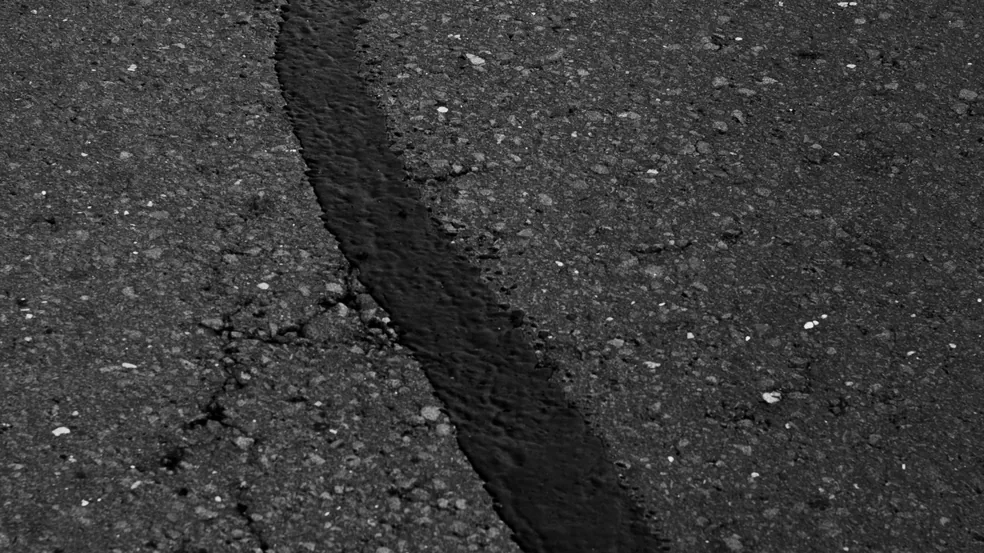
An open crack is a delivery system, and winter here uses it heavily
Everything expensive that happens to a commercial lot in this county happens below the asphalt. The asphalt is a wearing course. Load is carried by the compacted aggregate under it and spread into a subgrade that, across most of Greater Cleveland, is glacial till and lake-plain clay with poor drainage. Keep that aggregate dry and confined and it does its job for decades. Let water into it repeatedly and it stops being a structure.
A crack is the route in. Not a blemish on the surface, a route: a continuous opening running from the wearing course down into the material that carries the wheel loads. Rain, snowmelt and the runoff from a plough pile all find it, and gravity takes them the rest of the way.
Then the temperature crosses the freezing point and the water in there turns to ice, expanding by roughly nine percent as it does. That is the only time this page will state the mechanism, because the mechanism is simple and the consequence is what matters: that expansion has nowhere to go, so it pushes the crack walls apart and shoulders the surrounding aggregate aside. The thaw leaves a marginally wider crack over marginally looser base, ready to take on more water than it did before.
One crossing does almost nothing. The defining variable in this climate is not how cold the coldest night gets, it is how many times a season the pavement passes through freezing, and here that count is high. A crack left open through a Northeast Ohio winter is subjected to that cycle again and again, with deicing salt keeping water liquid and mobile for a good share of the hours it would otherwise have spent frozen and harmless.
That is why closing cracks outranks every other piece of pavement maintenance available on a lot in this region. It is not the most visible work, it never improves the look of a property, and it is the item most often cut when a budget tightens. It is also the one that changes what the lot looks like in three years.
What crack sealing actually involves
The work is more than running a bead of material along a line, and the difference between the two shows up in the first winter.
- Routing. A router cuts the crack into a reservoir of consistent width and depth, following its path. This sounds like extra work for no benefit and it is the step that decides service life. A raw crack is an irregular slot, often narrow at the top, with fractured faces. A cut reservoir gives the sealant a defined shape with proportions it can stretch within, and gives it clean, sound walls to hold onto rather than crumbled edges.
- Cleaning and drying. Compressed air, and frequently heated air, removes dust, grit, old material, vegetation and moisture from the reservoir. Sealant will not adhere to a dusty wall or a damp one. It will sit in the channel looking correct and separate from one face over the winter, which produces a sealed-looking crack that is still admitting water.
- Placing the material. A hot-applied rubberised sealant is brought to its working temperature in a kettle and placed into the reservoir, filling it rather than capping it. Depending on the specification it is left flush or finished with a thin band over the top.
- Cooling. The material sets within minutes to a flexible solid, which is why this work returns a lot to service quickly compared with almost anything else done to pavement.
What the cured material does through the year is worth understanding, because normal behaviour gets reported as failure. In January the pavement contracts and the crack opens to its widest; the sealant is in tension and stretches. In July the pavement expands, the crack narrows, and the sealant is squeezed, sometimes extruding slightly proud of the surface. A band that looks a little raised in August and a little sunken in February is doing exactly what it was chosen to do. What is not normal is material that has pulled cleanly away from one wall, which points at preparation, or material that has gone hard and split across its own width, which means it is at the end of its life.
Crack width moves with pavement temperature, so timing decides whether it fills or bridges
A crack is not a fixed dimension. It is widest when the pavement is coldest and narrowest when the pavement is hottest, and on a dark asphalt surface in direct sun the swing between those two states is considerable.
Seal a crack on a hot afternoon and you are filling it at close to its minimum opening. The material goes in, and there may be very little depth of reservoir to receive it, so what forms is a skin across the top rather than a plug within it. When the pavement contracts in December and that crack opens to its full width, the thin bridge has to accommodate the entire movement. It cannot, so it tears or peels away from a wall, and water uses the same path it always did.
Seal it at a moderate temperature and the crack is nearer the middle of its working range. The reservoir is open enough to take material down into it, the sealant is filling a shape rather than spanning a gap, and it has the depth to stretch as the opening widens.
This is the practical reason the work belongs in cooler weather rather than midsummer, and it is separate from the argument about winter. Both point the same direction.
The autumn window is the one that counts
Crack sealing is autumn work in this region. The lot is going to be tested between December and March, and material placed before the test is what the test meets.
Sealing the same cracks the following spring gets you the same invoice for materially less protection. The crack has already spent a winter taking on water at every thaw. Base aggregate has already been displaced. In several places what was a crack in October is now a crack with a soft area beside it, or a crack with a hole at one end, and sealing it in April closes a route into a base that has already lost material. The work is not wasted, it is just late, and late costs the difference between a crack and a repair.
Spring sealing has a second drawback that shows up in the schedule rather than the pavement. The spring queue is full of structural work that could not be done in the cold, and sealing competes with it for both budget and site access. Autumn is comparatively quiet, temperatures are in the range the material wants, and the lot gets closed up before the season that opens things.
There is one genuine argument for spring: a crack that appeared over the winter and is now open cannot wait eighteen months for the next autumn. Seal it when it can be sealed properly. The point is not that spring is forbidden, it is that a programme built around spring sealing is permanently one winter behind.
Which cracks are worth sealing, and which are not
Sealing is targeted work. Applied to the right defects it is the best value on a commercial property; applied to the wrong ones it is money spent to no effect at all.
Worth sealing
- Single cracks running the length of a lot or across it, with sound pavement on both sides, wide enough to route and fill.
- The joint between an old patch and the original pavement, which is a manufactured crack and one of the most reliable water entry points on any lot.
- Construction joints and the seams between paving passes, which open first because they were never as dense as the material either side of them.
- The line where asphalt meets a concrete curb, gutter pan, walkway or dock apron, where two materials with different movement habits are pulling against one another all year.
- Cracking around a utility trench or a casting that has been cut into the surface at some point.
- Block cracking in a rectangular pattern across a low-traffic area, where the individual cracks are still discrete and wide enough to take material. That pattern is age and temperature in the binder rather than load failure, and closing it keeps water out of an otherwise sound structure.
Not worth sealing
- Alligatored areas. Close-spaced interconnected cracking means the aggregate below has stopped spreading load and the surface now bends under each axle that passes over it. Sealing accomplishes nothing there. There is no discrete opening to route, the network is far too dense to treat piece by piece, the fragments between the cracks move independently under traffic, and closing the top restores none of the carrying capacity that has already gone. Those areas need removing full depth and rebuilding, and sealant spent on them is spent twice.
- Cracks with broken, crumbling edges or with a depression alongside. The walls will not hold material and the low spot says base is already going. That is patching work first.
- Hairline crazing confined to the surface layer, which is too fine to route or fill and is a surface ageing question rather than a route into the base.
- Any crack inside an area already scheduled for full-depth repair or for removal and replacement this season. Sequence matters more than thoroughness here.
Sealcoating, assessed without the sales register
A sealer is a cold liquid spread across the whole surface, drying to a flexible skin with fine aggregate suspended in it for grip. Once cured it measures a fraction of a millimetre. It exists to address one real condition, and it is worth being precise about what that condition is.
Asphalt is stone held together by a petroleum binder. Oxygen and ultraviolet light react with that binder continuously from the day the lot is placed, driving off the lighter fractions and leaving what remains stiffer and less able to stretch. That reaction is oxidation, and it works from the top down. The visible sign is colour: a black surface is binder-rich, a grey one is exposed stone with a hardened film still clinging to it.
Raveling is what follows. Once the stiffened binder can no longer hold the aggregate, the aggregate starts to leave, first as fine material and then as whole stones. The texture turns coarse, loose grit gathers wherever runoff drops it, and shallow pits open in the spots where a cluster of stones has departed at once.
Sealer is a sacrificial layer laid over that process. Traffic, grit, sun and brine work on the film rather than on the binder underneath it, and the film is renewed when it has been used up. On a structurally sound lot with an oxidising surface, that is a genuine and worthwhile purchase, and it makes the property look maintained, which is a legitimate thing for a manager to want.
The limits deserve stating just as plainly, and not one of them turns on which product was chosen or how many coats went down. Structural capacity is untouched: wheel loads travel through the aggregate and into the subgrade, and a skin measured in fractions of a millimetre takes no part in that at all. A crack that is still moving will not be closed by it either, since the opening travels further over one season than a cold, thin skin can stretch, so the coating splits along the line of the crack beneath it, frequently before the first winter is out. Nor will it correct a depression. Grade is geometry, and colouring geometry black leaves water standing in the identical footprint it stood in before, on a darker background.
And where a lot is failing from below, a fresh coating does something worse than nothing. It hides the evidence that would have caught the problem while it was still small, and it hides it for long enough that the condition survey done next year is reading a lot that has quietly got worse.
Deicing salt, and where a surface treatment earns its place
Salt does not attack asphalt chemically the way it attacks reinforced concrete. Its effect on a lot here is indirect and it is not small.
Brine stays liquid well below the point at which plain water would have frozen solid and stopped moving. On a heavily salted commercial lot that adds a great many hours per winter in which water can still work its way down into the pavement, and it leaves the surface wet at temperatures that would otherwise have rendered it inert. Add repeated wetting, partial drying and refreezing, and an already-oxidised surface gives up its fine material faster: brine works into the open texture of a raveling wearing course, and each cycle plucks a little more of it out.
The lots that take the most of this are the ones that get salted hardest and most often, which tend to be the ones with the most pedestrian traffic and the highest expectations: retail frontages, entrance drives, school and church lots cleared before every service or school day, and multifamily lots where the tenant parking has to be passable at six in the morning.
A surface treatment genuinely helps in one situation: a structurally sound lot with an open, oxidised, greying surface that is taking heavy salting. Closing that texture slows the loss of fines and gives the brine less to soak into, and there is real value in it.
It is cosmetic everywhere else. On young pavement whose binder is still doing its job, on a lot with alligatored areas or ponding, on anything with an overlay or a rebuild in the capital plan for the next year or two, the coating is a colour change. That can still be the right purchase for a property whose appearance matters commercially. It should just be bought with the eyes open, under the appearance line rather than the maintenance line.
Over-application is a real failure mode, and a short interval is a cost
Sealer is designed to wear away. Applied faster than it wears, it accumulates, and accumulated sealer behaves nothing like a single film.
A thick build has no aggregate skeleton and very little flexibility of its own. It cannot follow the asphalt beneath it as that expands on a hot afternoon and contracts overnight, so it fractures in a tight shallow web, much finer than anything the pavement itself would produce and stopping at the coating rather than continuing into the asphalt. Layers laid at different times have aged to different stiffnesses, so they also begin separating from one another and lifting in flakes. The result gets slick when wet, chips at every edge, and leaves a noticeable step along the line where coated asphalt meets a concrete walk or gutter pan.
A commercial lot makes this easy to spot, because the coating wears at wildly different rates across it. Drive aisles, entrances and the turn into a loading area scrub the film off quickly. Parking bays that hold a car most of the day, and perimeter areas nothing drives on, barely wear at all. A property resealed on a fixed annual calendar is therefore bare where it matters and building up a brittle crust everywhere else, which is the worst of both outcomes and is being paid for every year.
Read a short reseal interval as an expense rather than as diligence. Coating that is still in place has no reason to be renewed, and a schedule set without anybody checking whether it is still in place has been written by the billing cycle rather than by the lot. The better practice on a commercial property is to inspect the drive aisles and the bays separately, note where the surface has genuinely gone open and grey again, and let the pavement set the schedule.
Preparation, cure, and keeping an occupied site running
Sealer adheres to clean, dry asphalt and to very little else, which is why most early coating failures were decided before the material came out of the tank.
Cleaning is structural to the outcome, not cosmetic. Winter leaves a commercial lot covered in salt residue, sand and the loose fines the surface has already shed, and anything left in place works as a release layer: the coating grips the debris, the debris does not grip the pavement, and the lot sheds it in sheets. Doing it properly puts air and broom across the entire surface, with scraping and brushing wherever moss, soil or packed material has taken hold, and cutting back the earth and growth that has crept in over the edges, which on a perimeter nobody has examined in years can amount to a surprising width.
Oil and fuel spots are a separate operation, since no coating will hold over them. Petroleum products dissolve asphalt binder, and the softened, contaminated area repels a water-carried product. Those spots get scraped and degreased, and where the contamination has gone deep they need a primer made for the purpose. Skip it and the finished lot is uniformly black apart from a precise silhouette of every leak the property has ever hosted, back on view inside a few weeks. On a site with a delivery bay or a refuse corral that is a great many silhouettes.
Moisture and temperature govern the cure. The coating is carried in water and hardens by giving that water up, so damp pavement, a shaded section that has not dried since the last rain, or an overnight drop towards freezing while the film is still green all leave it soft, thin and poorly attached. Products have a working temperature floor, generally in the low fifties Fahrenheit, and what matters as much as the number is the direction: rising into a clear day rather than falling into a cold evening. Late in the season, the honest answer on a marginal day is to come back on a better one.
Traffic timing is the part that gets underestimated on an occupied property. People on foot can generally be let back after a day when conditions are good. Vehicles want longer than that, and a tyre pivoting in place on a green coating will lift it in a clean crescent. Phasing has to be agreed before anything is booked: which sections come out of use on which days, where traffic and people go instead, how accessible spaces and the routes from them to a door stay usable the whole time, and what happens to deliveries and waste collection while a dock or a corral cannot be reached. A retail property can often take a phased weekend. A school lot has a summer. A multifamily property usually needs overnight sections and a great deal of advance notice to residents.
One sequencing point gets reversed constantly: cracks are dealt with before any coating goes down, never by it. Coating flooded into an open crack loses volume as its water evaporates, settles well below the surface, and leaves a sunken dark channel that carries water down to the aggregate exactly as freely as it did before.
The decision rule, in three cases
Most of the above collapses into a short test that a property manager can apply from a walk of the lot.
- Buy both, sealing the cracks first and coating afterwards, when the pavement is structurally sound, water drains off it and does not stand, there is no interconnected cracking anywhere that carries traffic, and the surface has gone grey and open. This is a lot worth maintaining and appearance is part of what the property is selling.
- Buy crack sealing alone when the structure is sound but the surface still holds its aggregate, or when the budget will not stretch to both. Closing the routes into the base is where the return is, and a lot that is merely starting to grey loses nothing by waiting another season for the coating. On a large share of commercial properties in this county, this is the correct answer and it is not the one that gets proposed.
- Buy neither when the lot has alligatored areas in the drive aisles, water standing after every rain, or potholes that have been filled more than once in the same footprint. The money belongs in drainage and in full-depth repair, and a coating laid over that condition is paying to make the evidence harder to see. Get the structure right this year, seal the cracks in the autumn after it, and treat the surface the year after that.
Two products sold together, and only one of them protects the lot — common questions
If the budget only covers one of them this year, which do we buy?
Crack sealing, on almost any lot in Greater Cleveland that has open cracks. It closes the paths water uses to reach the base, and water in the base is the mechanism behind the failures that cost real money here. A coating slows surface ageing, which is a slower and largely cosmetic problem in its early years. If both are affordable, seal the cracks first and coat afterwards.
Why does the crack have to be routed? It seems like extra cost.
Routing cuts the crack into a reservoir of consistent width and depth with clean, sound walls. A raw crack is an irregular slot with fractured faces, often narrow at the top, so material caps it rather than filling it and has crumbling edges to hold onto. The reservoir gives the sealant a shape it can stretch within across a full temperature swing, and that is most of the difference between material that lasts several winters and material that lifts out of the first one.
Can we seal cracks in the middle of summer while a crew is already on site?
It is not the best use of the visit. Cracks are at their narrowest when the pavement is hottest, so a summer application fills the opening at close to its minimum and often forms a skin across the top instead of a plug within it. When the pavement contracts in December and that crack opens to its full width, the thin bridge has to absorb the whole movement and generally tears or pulls off a wall. Cooler conditions put the crack nearer the middle of its range.
Half the lot has cracking in a close, interconnected pattern. Can that be sealed?
No, and it is worth being blunt about it. That pattern means the aggregate under those areas has stopped spreading load, so the surface bends under each axle. There is nothing discrete to route, the fragments between the cracks move independently, and closing the top returns none of the carrying capacity that has gone. Those areas need removing full depth and rebuilding. Sealant spent there buys nothing.
Will sealcoating stop the potholes?
It will not. Potholes form when water gets into the base, freezes, displaces material and leaves a void that the surface eventually drops into. A coating a fraction of a millimetre thick adds no structural capacity, so it changes nothing about the load path or about the void. It will also not bridge a moving crack or fill a depression. It treats the wearing surface, and on a lot that is failing underneath it mainly makes the failure harder to see until it arrives.
Our lot gets sealed every year. Is that keeping it in good condition?
Probably not, and it may be creating its own defect. Sealer is meant to wear away and be renewed when it has; applied faster than it wears it accumulates into a brittle, multi-layered crust that crazes in a fine web and flakes off. On a commercial lot the wear rate varies enormously between drive aisles and parked bays, so an annual calendar leaves the aisles bare while building up everywhere else. Inspect the two separately and reseal when the surface has genuinely gone open and grey again.
Does road salt mean we should be sealing more often, not less?
It means a surface treatment is genuinely useful on one kind of lot: a structurally sound one whose surface has oxidised and opened up, and which gets salted heavily. Closing that texture gives brine less to soak into and slows the loss of fine material. It does not shorten the interval on a lot whose coating has not worn off, and on a lot with base failure or standing water it changes nothing at all about what salt is doing.
How long is the lot out of service, and can the work be phased?
Crack sealing hands an area back quickly, because the material sets within minutes of being placed. Sealcoating is the slower of the two: pedestrians can normally come back after a day in decent weather, while vehicles want more time, because a tyre pivoted in place will peel a green coating up in a crescent. Both phase reasonably well by section, and the closure plan, the pedestrian routing and the accessible parking arrangements are worth settling before a date is agreed rather than after.
Talk through your site
Start with the address, roughly how many square feet, and photographs of the worst areas and anywhere water sits after rain.
Related work
Parking Lot Paving
New lots and full reconstruction, from subgrade up.
Parking Lot Repair
Rebuilding the failed areas without closing the whole site.
Asphalt Repair
Patching, full-depth repair and what each failure says about the base.
Pothole Repair
Why Cleveland potholes come back, and what actually stops them.