Home › Services
One word, three projects, and a wide gap between them
Three genuinely different projects are sold under the single word paving. They differ by a factor of several in what they cost and by about a decade in what they buy, and what decides between them is underneath the lot where nobody has looked.
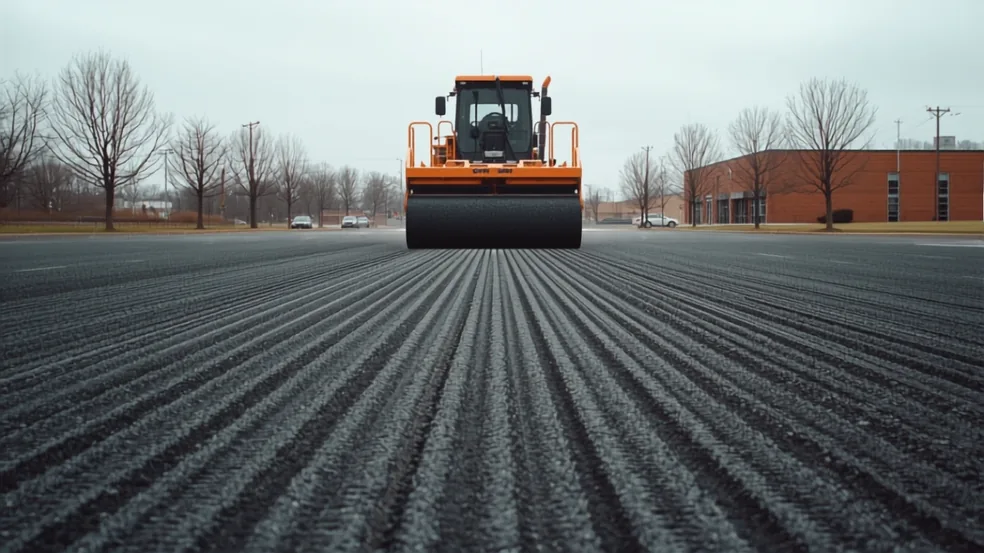
The word covers three separate purchases
When an owner says the lot needs paving, three entirely different projects are still on the table. One replaces the top of the pavement. One rebuilds the middle of it out of the material already there. One removes everything and starts again. They are not stages of a single job and they are not grades of thoroughness. They fix different things.
What separates them is not how much anybody wants to spend. It is what sits under the property, and specifically whether the layers meant to carry wheel loads are still doing it. A surface can look identical above a sound structure and above a finished one, which is why comparing prices between the three is the wrong opening move and why so many commercial lots in this county end up buying the one they did not need.
Age complicates it locally. Most commercial paving across Cuyahoga County was laid between the late 1950s and the early 1970s, designed for lighter vehicles arriving less frequently than they arrive today. A lot of that vintage can be structurally fine and a lot of that vintage can be structurally finished, and nothing visible from standing height reliably separates the two.
Mill and overlay
A milling machine removes a measured depth of existing asphalt across the whole area, leaving a clean textured face at the level the surface started at. New hot mix is placed over that and compacted. Because the same depth comes off as goes back on, the finished elevation does not change, which preserves the relationship with curbs, door thresholds, drainage inlets and every casting set into the pavement.
What it fixes is the wearing course. Oxidation, raveling, surface cracking, minor unevenness and the accumulated patchwork of small earlier repairs all disappear beneath a new, dense, uniform layer. Varying the milling depth can improve fall across the surface slightly, though only slightly. It is the least disruptive of the three, the shortest time on site, and by a distance the least costly.
The precondition is the whole of the decision. Everything below the milling depth has to be sound. The aggregate base has to be spreading load, the subgrade has to be supporting the base, and nothing underneath can be moving when a loaded vehicle crosses it. This project adds no structure whatsoever. It renews the one layer that was never carrying anything.
When that precondition is not met the failure mode is specific and quick. The structural problem below goes on flexing under every axle exactly as before, and that movement works up through the new asphalt until it opens along the same lines the old surface had opened along. In this climate it generally shows inside two winters, because the fresh surface is split by that movement and then handed the same count of freeze and thaw crossings as everything around it. The owner has now paid for a resurfacing and still faces the rebuild, and the rebuild costs more than it would have, because two layers have to come off instead of one.
Full-depth reclamation
A machine works across the property grinding the existing asphalt together with a measured part of the aggregate beneath it into one blended material, in place, with none of it leaving the site. The blend is graded, sometimes treated to improve how it holds together, and compacted as a new base. Fresh asphalt is then placed over it in lifts.
The appeal is the arithmetic of material. On a large property the existing asphalt represents a considerable tonnage of stone and binder already sitting where it is needed and already paid for once. Reclaiming it avoids hauling that away and avoids hauling replacement aggregate in, and those two movements are a real share of what a rebuild costs. It also delivers something a heavily patched property cannot otherwise obtain: a base of consistent quality end to end, in place of a mosaic of original construction and decades of repairs made to varying depths by varying hands.
It is the right answer where structural distress is widespread rather than local, where there is enough existing thickness to blend into a useful base, where the subgrade is workable, and where there is room for the equipment to operate. Larger retail, industrial and institutional properties fit that description more often than small ones, because the method needs space and its economics improve with area.
What it cannot overcome is the ground. Reclamation improves the base. It does not repair a subgrade that cannot support a base. On the slow-draining clay and till common across this county, a property whose real problem is soft saturated soil will end up with a beautifully uniform reclaimed base deflecting in exactly the same places as before, because the layer that was failing was never touched. Where the subgrade is the issue it has to be dealt with underneath, by excavating and replacing unsuitable material or by improving it in place, and whether a given site needs it belongs with a geotechnical professional rather than with an assumption made from a bid sheet.
Complete reconstruction
Everything comes out. Asphalt, aggregate base, and whatever depth of unsuitable material lies below that. The exposed subgrade is examined, proof rolled with a loaded vehicle while somebody watches for movement, and corrected wherever it yields. New aggregate is placed and compacted in controlled layers, and new asphalt goes down over it in lifts. What results is a new pavement, designed rather than inherited.
The conditions that force it are not subtle once you know what forces it. A subgrade that will not carry load until it is fixed. Existing thickness too thin to blend into anything useful. Grades that send water somewhere it cannot leave, which is a geometry problem that no amount of resurfacing solves because geometry is the thing that is wrong. Underground work that has to happen anyway, since nobody pays to trench a new surface twice. And a structure so far past its capacity that whatever gets rebuilt from the old material would fail under the traffic now crossing it.
On the day it is the most expensive of the three by a wide margin. Across a long enough horizon it is sometimes the cheapest, and the mechanism behind that is straightforward. It is the only one of the three that changes what the pavement is able to carry. A property rebuilt to suit the vehicles actually using it stops generating repair work, while a property receiving surface projects over a failing structure generates repair work continuously and then receives another surface project when the first stops being enough. Two resurfacings and five years of patching is not a cheaper route. It is the same money arriving in instalments with a rebuild still waiting at the end of them.
Reconstruction is also the only one of the three where the property can be redesigned instead of reproduced. Where water goes, which lines the heavy vehicles travel, how much section sits under the aisles taking delivery traffic against the bays that only hold parked cars: all of it is open while the ground is open, and none of it is open again for a very long time afterwards.
How you find out which one you need
The honest answer is that somebody opens the pavement. A core is a plug taken right through the full pavement section and lifted out, and in a few minutes it reports things that no amount of walking the property will produce.
- The real thickness of asphalt, which is frequently not what anybody believed and frequently varies across a property built in stages or resurfaced at some point in its history.
- How many layers there are and where the joints between them sit. A core arriving at the surface in separate discs has already reported that those layers have come apart from one another, which is a structural finding on its own.
- The state of the aggregate below: clean interlocked stone, or material that is wet, contaminated with fines, or no longer a distinct layer at all.
- Whether water is present and at what depth. Moisture at the bottom of a core taken during a dry week is a far stronger finding than any observation made from the surface.
- What the subgrade actually is at that spot, which on till and lake-plain clay is worth establishing before anybody specifies a base depth.
What a surface inspection cannot tell you is that entire list. A surface reports where the pavement has already failed. It does not report why, it does not report at what depth, and it says nothing at all about the areas that have not failed yet but are close. Two properties with indistinguishable surfaces can need the least expensive and the most expensive of the three projects respectively, and no amount of experience looking at the top of them settles it.
Cores get taken at several locations rather than one, because a commercial lot is not uniform. The pattern across them is the finding. Consistent thickness and firm base everywhere points one way. Wet contaminated base under the aisles with dry intact base under the bays points at a split answer, where the aisles are rebuilt and the bays are resurfaced, which is often the cheapest outcome available and is invisible without the cores.
The reason to insist on this before a price is discussed is that the gap between the three projects is precisely where change orders come from. A property specified as a resurfacing on surface evidence, which turns out on the first morning to have a base that will not hold, becomes a rebuild with the equipment already mobilised and the owner holding a figure that no longer describes anything. The information was available beforehand and was not bought, so the factor-of-several difference reappears later as a variation nobody planned for and nobody budgeted.
The season is a live constraint on all three
Hot mix is placed hot and gains its strength as it cools, so every part of the operation has to finish inside a window during which the material is still workable under a roller. Air temperature, the temperature of whatever it is laid on, wind and the thickness of the lift all govern how wide that window is. Late in the season all four move the wrong way together.
Compaction suffers first and it suffers invisibly. Material that cools before it has been rolled to density keeps a network of connected voids running through it. Those voids pass water and admit air to the binder from within, so a lift placed too cold looks like finished pavement on the day and ages like something much older than it is. Nobody can see it. It surfaces years later as raveling and cracking arriving earlier than they should have.
The remaining constraints concern the ground rather than the mix. Aggregate cannot be compacted properly into saturated or frozen material. A subgrade cannot be assessed honestly while it is frozen, which makes soft ground read as firm, or while it is waterlogged, which makes ordinary ground read as hopeless. And reclamation needs the existing material at a moisture condition that allows it to be blended and recompacted, which a wet late autumn will not provide.
So the season here is short and it closes, and a project that misses it does not resume in a few weeks. It resumes after a winter, and what that winter costs is a mechanism rather than an inconvenience. A property left open through it takes a full run of freeze and thaw crossings into every opening that was going to be removed anyway, absorbs repeated salting and plough traffic across edges already breaking down, and arrives in spring having lost more base material than it had lost in October. On a property already committed to a rebuild that may change little. On one that was a candidate for resurfacing it can move it out of that category entirely.
The practical instruction is to make the decisions early in the year rather than late. Cores in spring, scope settled in early summer, work inside the placement season. A decision reached in September is a decision about next year whether or not anyone intends it to be.
Settle these before a number is discussed
This is not a bid comparison list. It is the set of things that have to be known before any bid can mean anything at all, because until they are known the three projects have not yet been separated from one another.
- What is under the property, taken from cores at several locations, with thickness, layer condition, aggregate condition and moisture written down.
- Where water currently goes and where it is meant to go, including whether the existing inlets actually sit at the low points the finished surface creates.
- Which heavy vehicles cross the site, how often, and along which lines. This decides whether one section suits the whole area or whether the aisles and the bays should differ from one another.
- What underground work is outstanding. Conduit, drainage, sleeves and anything else that has to cross the pavement crosses it before the stone goes down, never afterwards.
- Whether the property can lose parts of itself, when, and for how long. This constrains the method as much as the schedule, since reclamation and reconstruction take an area out of use for considerably longer than a resurfacing does.
- What the ownership horizon is. A site being held for twenty years and a site being prepared for sale are asking genuinely different questions, and the right project is not the same one in both cases.
Once those six are settled the three projects sort themselves quickly, and the conversation about price becomes a conversation about one scope rather than three different ones wearing the same name. Markings are reinstated at the close of any of the three, which is a finishing item rather than part of the decision.
One word, three projects, and a wide gap between them — common questions
Can we just resurface the lot and deal with the rest later?
Only if the layers under it are still carrying load, which cannot be established by looking at the surface. Resurfacing adds no structure, so where the problem sits below, the movement works up through the new asphalt and opens it along the old lines, usually within two winters here. The later bill is then larger than it would have been, because both layers have to be removed.
What does a core actually tell you that walking the lot does not?
It gives the real asphalt thickness, the number of layers and whether they are still attached to one another, the condition of the aggregate beneath, whether water is present and at what depth, and what the subgrade is at that spot. A surface can only report where failure has already broken through. It cannot report the depth of the cause or identify areas that are about to fail.
Is full-depth reclamation a cheaper alternative to rebuilding?
It is cheaper, but it is not the same purchase, so it is only an alternative where the conditions suit it. Reclamation rebuilds the base out of material already on site and removes the hauling in both directions. It does nothing for a subgrade that cannot support that base, and on the slow-draining soils common in this county the subgrade is often exactly where the problem lives.
Our lot is a patchwork of old repairs. Which of the three suits that?
A heavily patched surface over a base that is still sound can take a resurfacing, while a heavily patched surface over a failing base is a strong candidate for reclamation, because that method produces one uniform base where there were dozens of different depths. The patchwork itself does not answer the question. Cores taken through several of those repairs do.
Why do bids for the same project differ so widely?
Usually because they are not describing the same project at all. One may be pricing a resurfacing, another a rebuild, and a third something in between, with different assumptions about what will be found underneath. Establishing what is down there first, then issuing one scope to everybody, is what turns three unrelated numbers into a comparison that means something.
How late in the season can a lot be paved around Greater Cleveland?
The limit is set by placement and compaction rather than by a date. Material has to be rolled to density before it cools, and compacting stone into ground that is waterlogged or frozen does not work. As autumn closes both conditions deteriorate together, and a lift placed too cold keeps connected voids through it that shorten its life without ever being visible on the day.
Does the whole lot have to get the same treatment?
No, and assuming it does is one of the more expensive assumptions an owner can make. Aisles carrying delivery and refuse vehicles frequently need rebuilding while the bays either side of them only need a new surface. Cores taken in both areas are what reveal the split, and treating them differently commonly costs less overall than applying one method across the entire property.
Talk through your site
Start with the address, roughly how many square feet, and photographs of the worst areas and anywhere water sits after rain.
Related work
Parking Lot Repair
Rebuilding the failed areas without closing the whole site.
Asphalt Repair
Patching, full-depth repair and what each failure says about the base.
Pothole Repair
Why Cleveland potholes come back, and what actually stops them.
Sealcoating & Crack Sealing
Surface protection, crack sealing, and the limits of both.