Home › Services
Winning the pavement argument one budget season at a time
The manager who gets pavement funded is rarely the one with the most alarming photographs. It is the one who can show, in mechanism rather than adjectives, what one more deferred season does to the property.
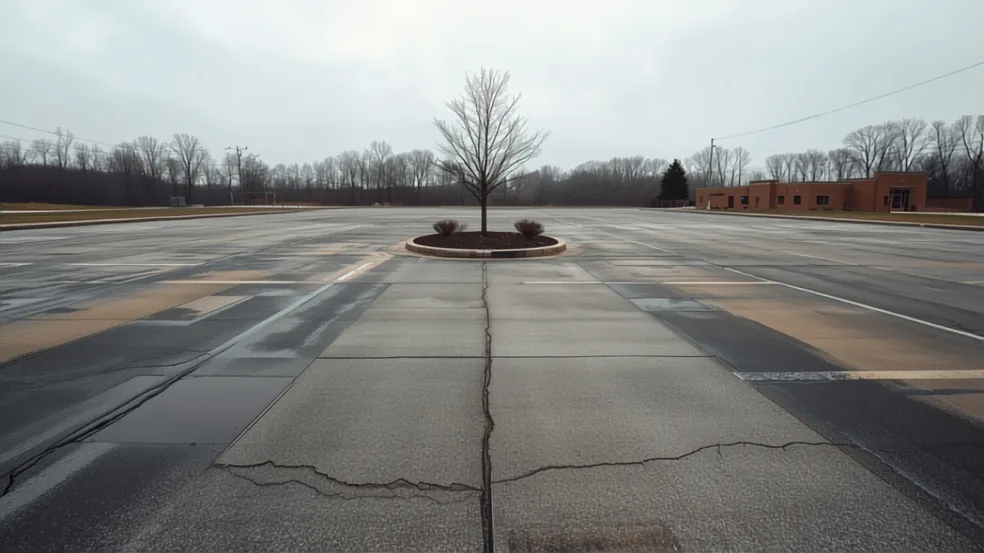
Pavement is the only building system with no meter on it
A roof leak announces itself through a tenant. A failing chiller turns up on a utility bill. Pavement has no equivalent signal. It degrades quietly along a curve that stays nearly flat for years and then turns steep, and by the time it generates a complaint the inexpensive window has already closed behind it.
So the work that decides whether a commercial lot stays affordable is not done with a saw. It is done in the twelve months before a request goes in. Repair programmes are approved or refused on the strength of the record standing behind them, and most properties have no record at all beyond a folder of invoices that say what was bought without saying what it was for, how deep it went, or whether it held.
This page is about that side of it. What is worth recording, how recurrence is presented, which categories genuinely get more expensive while a decision is pending, and how any of it is put in front of a finance function without anybody inventing a figure.
Condition assessment is an information exercise, not a verdict
The instinct is to treat the annual walk as an inspection that produces a judgement. It is far more useful to treat it as a measurement that produces a series. A judgement is one person's opinion on one afternoon. A series is evidence, and evidence is what survives contact with a committee that has eleven other requests in front of it.
One practical consequence is worth stating bluntly, because it inverts what most people assume. A modest record captured at the same point every year is worth considerably more than an excellent record captured once. Consistency is the property that lets a record show change, and change is the only thing that proves a mechanism is running rather than a condition simply existing.
Late winter is the honest season for the exercise. The property is at its worst in February and March, and defects that hide under a dry summer afternoon are all on display. A survey taken then produces a scope that matches what a contractor will actually find when the season opens.
- Fixed camera positions. Choose a set of standing points, mark them on a simple plan of the property, and take the identical frames from the identical places every year. Put something of known size in the shot so a later comparison means something.
- Where water lies after rain and how long it takes to clear. This is the single most informative observation available on a commercial property, and it costs one wet afternoon and a note on a plan.
- Every repair, located on that plan, with four fields: what was done, what depth it reached, whether aggregate below was opened and replaced, and who carried it out. Depth is the field omitted most often and the one that matters most two years later.
- Where ploughed snow was stockpiled that winter. A corner receiving every pile from December to March absorbs a season of saturation and repeated refreezing that no other part of the property experiences.
- The approximate age of the pavement and of any resurfacing, as far as anyone on site can establish it. An owner who cannot answer that has already found one thing worth putting in the record.
- Plain notes on anything that changed in how the property is used. A new tenant, a relocated refuse enclosure, a delivery door moved to the other side of the building. Load history explains more distress than age does.
Recurrence is the strongest evidence a manager can hold
Of everything a record can contain, one item outranks all the rest: the same footprint failing more than once. A single defect is a condition. The identical defect in the identical place across three seasons is a mechanism, and a mechanism is an argument rather than a complaint.
It carries weight upward because it removes the two objections that kill pavement requests. It removes the suspicion that the work was simply done badly, since something made and remade has now been tried twice. And it removes the hope that the problem is cosmetic, because cosmetic problems do not return after being cut out and carried away.
Presenting it is a matter of arrangement rather than rhetoric. Put one location in a row. Dated photographs in sequence, the date of each repair beneath them, the depth each one reached, and the interval between them. If those intervals are shortening, let the row say so without commentary. Nothing in that presentation requires an estimate, a projection or a statistic, which is exactly why it is difficult to argue against.
The sentence that follows the row is the one that changes the decision, and it should name a depth. This location has been repaired twice without anything below the wearing course ever being opened, so the assumption that asphalt was the problem has not yet been put to any test.
A repair programme that spans several budget years
A property needing attention in twelve places does not need twelve jobs this year, and a proposal insisting otherwise usually results in the whole list being pushed. The shape that gets funded is a programme: an ordered sequence across three or four budget years, with the ordering justified on mechanism instead of severity.
Year one takes the items whose cause is still actively running. Not the ugliest, not the largest, and frequently not the ones tenants mention. The test is short. If nothing happens here, will the thing that has to be repaired next year be physically bigger than the thing in front of me now? If yes, it belongs in year one, and it belongs there even when it is small and unremarkable.
Later years take the items whose condition is essentially static. An oxidised surface on firm pavement genuinely waits. So does a tight opening in a bay that nothing crosses and no runoff reaches. So does the visible outline of an older repair that is flush and stable, which is a line on the surface rather than a defect in it.
Something useful falls out of writing it this way, and it is worth pointing at when the document goes up. The total normally shrinks. Several entries got onto the list because of how they look and turn out to need nothing below the surface at all, and saying so in writing is what gives the remaining entries their credibility.
The four categories that compound, and the reason each one does
Deferral is not uniformly expensive. Plenty of items cost the same next year as this year, and pretending otherwise damages the rest of the argument. Four categories genuinely do not, and in each case the reason is a physical process continuing at its own rate with no regard for a budget calendar.
An opening going into a winter
The opening is a continuous route from the surface down into the aggregate that carries wheel loads. Water enters it, and every time the pavement passes through freezing that water expands, levers the walls apart and shoulders the stone beside them out of position. The thaw leaves a marginally wider route above marginally looser material, so next season it admits more than it did this one.
The variable that drives this in Northeast Ohio is the count of crossings through a season rather than the depth of the cold, and heavy repeated salting raises that count by keeping water liquid and mobile through hours it would otherwise have spent frozen and inert. An opening deferred is not the same opening in twelve months. It is a wider one over weaker material, and often one with a soft area alongside it that was not there in the autumn.
An area where water stands
Ponding sits directly above the part of the subgrade most likely to be saturated already, and lake-plain clay and glacial till give it up slowly. Saturated soil carries less than the same soil dry, so the pavement above it keeps settling, and settling makes the dish deeper.
That is why this category accelerates rather than merely persisting. The area holds more water next year than it holds this year, for the plain reason that this year it got deeper. Through the winter it freezes and thaws as a body, and any opening running through it is being worked from both sides at once.
Base loss beneath a repair that has already failed
When a repair fails inside its own footprint, material is leaving from beneath it, which means water is arriving there and not draining away. The cavity does not hold still while a decision is pending. Each wet and cold cycle takes a little more fine material out of the aggregate, the unsupported span grows outward past the original cut line, and the excavation finally required gets sized by the cavity rather than by whatever opening is visible.
Deferring this item does not defer the same excavation to a later date. It commits to a larger one. It is also the category where the mechanism is most easily demonstrated, because the earlier repair is right there on the record with a date and a depth against it.
An edge that has lost its lateral support
Asphalt at the perimeter is held sideways only by whatever it bears against: a curb, a concrete gutter line, or compacted earth at the same level. Where that support has eroded, been scraped back by a plough blade over several winters, or washed out where runoff leaves the pavement, the edge has nothing to push against and begins breaking away in pieces under any vehicle running near it.
The failure travels inward from the perimeter a little each season and accelerates wherever meltwater crosses that point. It is one of the few defects where doing nothing visibly costs area, which makes it unusually easy to show in a photograph series and unusually easy to ignore until the loss is substantial.
Putting it in front of a finance function
Finance does not act on adjectives. Deteriorating, poor and urgent carry no information that can be weighed against another department's request, and a case built from them competes badly against one built from numbers, even numbers attached to something less important.
What can be presented without inventing anything is the mechanism and the record. State what is physically happening at each location. State that it continues whether or not the item is funded. Show the photograph series proving it has been continuing. Then state plainly which entries on the list do not behave that way and can move to a later year. A list containing things that can wait is far more persuasive than a list on which everything is critical.
Frame the request in the vocabulary the function already uses: an ordered programme, a scope per year, and a stated consequence of moving any given year outward. Do not attach a multiplier, a percentage or a projected saving unless somebody has genuinely calculated it for this property. An invented ratio is the fastest way to lose the argument in the second meeting, and the mechanism was the stronger argument anyway.
Include the seasonal constraint before anybody asks about it. The hot mix season in this region is short and closes in the autumn, so an approval landing in November does not produce work in November. It produces work the following year, after the property has been through one more winter with the same openings still admitting water. Saying that in the request changes how the timing of the decision itself gets treated.
Capital and operating treatment, in general terms only
How a piece of pavement work is classified affects how it gets approved, which budget it draws on, who signs for it, and in some organisations whether it can proceed at all in a given year. It is common for smaller repair work and for replacing a section outright to be handled differently from one another, and for that difference to influence the decision more than the engineering does.
That is the whole of what can responsibly be said here. How any particular scope should be classified depends on the organisation, on its own policies and on the applicable rules, and it is not a question a paving contractor is in any position to answer. Take it to your own finance function and to whatever professional advisors your organisation engages, take the scope description with you, and do it early.
The practical point for a manager is narrow. Find out before the programme is written rather than after. A programme structured without knowing which budget it can draw from is a programme that gets restructured, and restructuring almost always means resequencing the work, at which point the year-one entries are no longer the ones whose mechanism is running.
Continuity is worth more than any single scope
Multi-year programmes get rebid annually on the assumption that this is prudent. On pavement that habit carries a cost which never appears in the comparison, because what is being lost is not skill. It is memory.
Whoever opened a section last year knows what was under it. They know the depth at which firm material was finally reached, whether the aggregate came out wet, where the water seemed to be arriving from, and how much larger the excavation turned out to be than the drawing said. None of that is in a proposal document. All of it should shape the following year of the programme.
The way to keep that knowledge without committing to anybody in particular is to make the record yours rather than theirs. Ask for excavation depths in writing at the close of every job. Ask what was found below the asphalt and have it noted against the location on the plan. Photograph the open excavation before it is backfilled, which takes a minute and is the only opportunity anyone will ever have to see that layer. Do those three things and continuity stops depending on who wins the next round of bidding.
It also makes bids genuinely comparable for the first time. When every contractor is pricing against the same documented history, with depths and dates attached, the spread between their numbers narrows sharply, and the ones still far apart are usually far apart for a reason you are now in a position to ask about.
Winning the pavement argument one budget season at a time — common questions
How often should a commercial lot be formally assessed?
Once a year is enough, provided it happens at the same point each year and from the same vantage points. The consistency is what creates value, because it lets one year be compared against the next and turns a set of observations into evidence that a process is running. A thorough one-off survey followed by four years of nothing tells you the condition on one afternoon and nothing about direction.
What should be recorded that most properties do not record?
The depth every repair reached, whether aggregate below the asphalt was opened and replaced, and where ploughed snow was stockpiled that winter. Invoices capture what was purchased and almost never capture any of those three. Without depth on the record, a location that has failed repeatedly cannot be distinguished from one that has simply never been repaired properly.
Our finance team wants a number for what deferral costs. What can we give them?
Give them the mechanism and the measured history rather than a figure nobody has calculated. Show the same location photographed across three seasons, with repair dates and depths beside the images and the intervals between failures written out. An invented multiplier or percentage will be challenged and will weaken everything around it, while a documented series showing an area growing is difficult to dispute.
Which items genuinely can be pushed to a later budget year?
Anything whose driving process has effectively stopped. A greying oxidised surface on firm pavement, tight openings in a bay that nothing drives across and no runoff reaches, and the visible outline of an old repair that sits flush and stable are all postponable. Saying so explicitly in the document is what makes the case for the items that cannot wait, since it shows the list was sorted rather than simply totalled.
Is it better to spread repairs across several years or do everything at once?
For most commercial properties a staged programme is both more fundable and better engineering, because it lets the items whose cause is still running be dealt with first while static conditions wait. Doing everything at once only makes sense where enough of the surface is structurally involved that repairing location by location would cost more in total than rebuilding the area. A record covering several seasons is what shows which of the two situations you are in.
Does it matter whether we use the same contractor across a multi-year programme?
It matters less than whether the information survives between years. What a contractor learns opening a section, the depth of firm material, the state of the aggregate and where water appeared to be coming from, is worth more than any single scope document. Capture those findings in your own records at the end of each job and you keep the continuity whether or not the same firm returns.
When should we start planning if we want work done next season?
Begin with a late-winter survey and have the scope settled well before the placement season opens. The hot mix season in this region is short and closes in the autumn, and approvals arriving late in the year produce work the following year rather than that one. Planning on that calendar also means the property is not carrying open defects through an additional winter while a decision moves through an approval chain.
Talk through your site
Start with the address, roughly how many square feet, and photographs of the worst areas and anywhere water sits after rain.
Related work
Parking Lot Paving
New lots and full reconstruction, from subgrade up.
Asphalt Repair
Patching, full-depth repair and what each failure says about the base.
Pothole Repair
Why Cleveland potholes come back, and what actually stops them.
Sealcoating & Crack Sealing
Surface protection, crack sealing, and the limits of both.