Home › Services
Five repair methods, and what each one actually buys back
Very little of the repair money wasted on commercial property in this county goes to poor workmanship. It goes to a sound method applied to a situation that needed a different one.
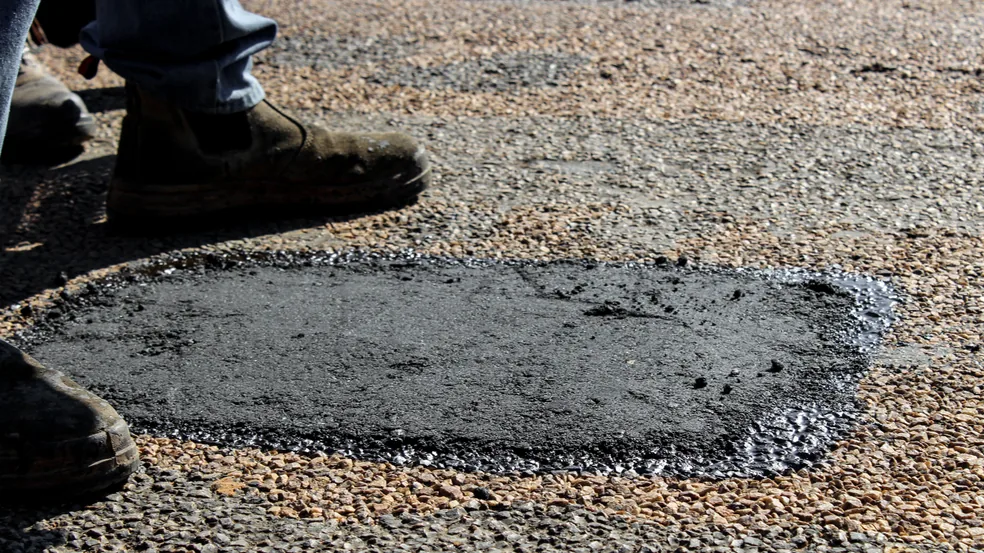
There is no such thing as a unit of repair
Ask what asphalt repair costs on a commercial property and the answer usually arrives as a rate applied to the area of visible damage. That framing is where the waste begins. Repair is not one operation priced by area. It is five distinct operations reaching five different depths into the pavement, and the distance between the lightest and the most thorough is a large multiple rather than a margin.
Every one of them is correct somewhere. Not one of them is a thriftier version of another. A thin patch is not an economical rebuild, and a rebuild is not a meticulous crack seal. They address separate defects, and the only question that sorts them is how far down the failure sits.
That question carries a local slant. The bulk of commercial paving across Cuyahoga County dates from the late 1950s to the early 1970s, built to a section chosen for the vehicles and delivery frequencies of that period. What crosses those lots now is heavier and arrives more often, and the ground beneath them is glacial till and lake-plain clay that gives water nowhere quick to go. Failures here therefore sit lower in the pavement than an owner tends to expect, and the methods that only reach the top get bought far more often than the evidence supports.
Four questions to put to any method before agreeing to it
Each section below answers the same four. What the operation physically does to the pavement. Which condition it gives back and which it deliberately leaves alone. The preconditions that make it the correct selection. And how the finished work behaves once the property has been through a Northeast Ohio winter. The fourth gets skipped in most conversations, and in this region it is the one that decides whether the repair is still there in April.
Crack treatment
The physical work. A discrete opening is cut into a reservoir of even shape, blown clean and dry, and filled with a hot rubberised material that remains flexible once cool. It goes into individual cracks with firm pavement on either side of them.
What it gives back, and what it does not. It restores the waterproofing of the surface along one line and nothing else. Carrying capacity on the day after is identical to carrying capacity on the day before. Everything beneath the wearing course is untouched, which is the entire point. This is a preventive measure taken while the layers underneath are still intact and still worth protecting.
Preconditions. A defined opening with walls firm enough to hold material, pavement either side that does not deform under a wheel, no dish alongside it, and no close interconnected cracking nearby. A dry surface at placement. It is disqualified by exactly the conditions that make it look most urgent, which is why so much of it gets spent where it can do nothing.
Afterwards, through a winter. This is the method whose whole purpose is winter. A closed opening denies the season somewhere to act, and the variable that matters in Northeast Ohio is how many times the pavement passes through freezing rather than how low the thermometer goes on the worst night. Expect the material to stand marginally proud in July heat and to sit marginally low in a January cold snap. A blade will find any bead left noticeably high, so finishing flush matters more here than it would in a milder place.
Skin and surface patching
The physical work. A thin layer of new asphalt is spread over the existing surface across a defined area and compacted, with little or nothing removed first. Edges are feathered or cut shallow. At its simplest it is material laid on top of the problem.
What it gives back, and what it does not. Ride quality, texture and appearance across that area, plus a closed surface for as long as the new layer stays attached to the old one. It returns no structural thickness, because it sits above the original surface rather than replacing anything that failed. Every layer under that original surface is left exactly as found.
Preconditions. The defect has to be genuinely confined to the top, the existing surface has to be firm with no movement under a loaded vehicle, and there has to be somewhere for the new edge to die out that does not leave a lip. It suits a raveled area on solid ground, shallow scuffing, and a surface that has weathered open while everything below it stayed dry and confined.
Afterwards, through a winter. This is the most vulnerable of the five once it is down. A thin lift over an old surface carries a joint around its entire perimeter and has almost no thickness with which to resist a plough blade. Where it was laid across an area that was in fact failing lower down, the first winter finds it out. Water travels beneath the new layer along the old openings, more aggregate leaves, and the patch sinks or breaks up as a single piece. On a county of slow-draining clay this is the most dependable way to pay for the same square yard twice.
Mill and patch
The physical work. A milling machine grinds a measured depth of existing asphalt out of a defined rectangle, leaving a clean level floor and vertical walls. Hot mix is placed into that box and compacted, normally in more than one lift. The finished surface returns to the grade it started at rather than standing above it.
What it gives back, and what it does not. A full-thickness section of sound wearing course, keyed against vertical faces of the surrounding pavement and level with it. The perimeter is a genuine joint that can be compacted, rather than a feathered edge that cannot. The aggregate base and the subgrade are never reached, never inspected and never improved.
Preconditions. The asphalt above the milling depth has to be the layer that failed, and there has to be enough of it to mill into without breaking through to base. Correct for a surface that is cracked, raveled or shoved through its upper courses while the layers below still spread load. Wrong anywhere a loaded wheel produces visible movement.
Afterwards, through a winter. It performs well, and geometry is the reason. Vertical faces and a level floor confine the new material on every side, so the joint closes up dense instead of open. The failure worth watching for is a box taken down to within a whisker of the base on a property where water is already getting in. The thin remnant below the patch is then the weakest part of the section, and it is what cracks first.
Infrared restoration
The physical work. Radiant heat is held over a marked area until the upper inches of asphalt soften enough to rake. That softened material is broken up and reworked, a small quantity of fresh mix and a rejuvenating agent are folded into it, level is corrected, and the area is rolled while everything is still hot. Since the repair and the pavement around it are soft at the same moment, the two merge and no cold perimeter joint exists at all.
What it gives back, and what it does not. Surface level and surface continuity, without introducing the ring of joint that every cut repair carries with it. Whatever the heat does not reach is untouched, which is most of the pavement. It adds no thickness and it replaces no material that has already departed from below.
Preconditions. The defect lives in the top inches. The ground beneath is firm and dry. The existing asphalt still holds enough binder to soften and knit rather than scorch, which excludes heavily oxidised and badly raveled surfaces. Fuel or oil contamination rules it out, and so does any defect reaching deeper than the heat penetrates.
Afterwards, through a winter. Where the preconditions genuinely held, this is the best-behaved repair on the list. A jointless perimeter gives meltwater no edge to enter at and gives a blade nothing to catch, which on a heavily ploughed property is worth a great deal. Where the preconditions did not hold, it is the most disappointing of the five, because on the day it is finished it looks better than any of the others while the cavity underneath is exactly as it was. That combination is why it gets proposed for structural problems more often than it should be.
Full-depth removal and replacement
The physical work. A clean perimeter is saw cut well outside the visible damage. Asphalt comes out, and digging continues downward until what is being stood on is firm and does not yield underfoot. Anything that has turned to slurry or lost its interlock is carted away. Replacement stone is placed and compacted in measured layers, then asphalt returns in lifts, each rolled before the next arrives.
What it gives back, and what it does not. The load path. Alone among these five it changes what the pavement can carry, because alone among them it rebuilds the layers that do the carrying. What it leaves entirely unaddressed is wherever the water was coming from, which is a separate question with a separate answer. A rebuilt section sitting below an unresolved drainage problem inherits the history of the one it replaced.
Preconditions. An open hot mix season, an excavation that can be kept free of standing water and ice, room for a truck and a roller, and an agreed arrangement for taking that part of the property out of use, since it carries nothing at all until it is finished.
Afterwards, through a winter. A properly rebuilt section is the one part of an old property that behaves like new pavement, because that is what it is, all the way down. It costs several times what surface work over the same footprint costs. On any location that has already been repaired once, it is usually the cheaper decision measured across three seasons instead of one.
When the honest answer is that none of the five applies
There is a condition at which method selection stops being the question worth arguing about. When the areas wanting full-depth work have stopped being discrete rectangles and have joined up along the aisles, when loaded vehicles produce movement in several unconnected places, and when the property has absorbed repairs in more locations than anybody can list from memory, the pavement is not failing at points. It is failing generally.
Repairing a property in that state location by location costs more in total than rebuilding the section, and leaves a mosaic behind when it is done. No percentage marks the threshold. The signal is arithmetic. The coming year of repairs, added to the last two, has begun to approach what replacing that area outright would cost, and the trend across those three numbers is upward rather than flat.
A property that has crossed that line is better served by a reconstruction conversation than by a sixth repair proposal, and a contractor willing to say so in writing has saved the owner a year of spending on work that cannot succeed. The short placement season sharpens the point. Work deferred past the autumn close does not resume a few months later against the same scope. It resumes against a larger one.
A sequence you can work through standing in the lot
None of this needs equipment. Walk to the defect and take the questions in order. The first one that comes back yes ends the sequence and names the answer.
- Does water stand here after rain, or is there a rim of dried silt marking where it stood? If so, grade and drainage are the defect, and no method above addresses either. Settle where the water is supposed to go before spending anything on asphalt.
- Has this exact footprint been repaired before? If so, the earlier work has already reported that the failure sits deeper than that repair reached. The choice is full depth, or finding out why water keeps arriving at that spot.
- Does the cracking interconnect and enclose pieces, or run as a single line with two ends? Enclosed pieces where vehicles load or turn mean the layers below have stopped spreading weight, and only full-depth work reaches that. A single line across firm pavement is crack treatment and nothing more.
- Watch a delivery vehicle or a refuse truck cross it. Does anything flex, dip or rebound as the axle passes? Visible movement is a structural answer no matter how presentable the surface looks.
- Put a probe into the edge of the opening. Does it meet firm material, or does it sink and come back out carrying wet fines? Wet fines mean water has already reached the aggregate, and the repair depth has to follow the water rather than the crack.
- If every answer above is no, the defect really is in the surface, and the remaining choice is between infrared, mill and patch, and a surface patch. It turns on how much sound thickness is there, whether a perimeter joint matters in that particular location, and whether the surrounding asphalt still holds enough binder to be reworked.
- Last, check the calendar before agreeing to anything. The hot mix season closes in the autumn here, and a structural repair pushed past that close does not simply wait. It sits through a full run of freeze and thaw crossings, heavy repeated salting and plough traffic, all working on an opening that is already admitting water, and the rectangle that has to come out in spring is bigger than the one being looked at now.
Markings disturbed by an excavation are reinstated once the new surface has taken traffic, but that is a closing item on a work order rather than a consideration in choosing between the methods.
Five repair methods, and what each one actually buys back — common questions
Which repair method is the cheapest?
Crack treatment, by a wide margin, and that is only useful information if the defect in front of you is a crack in otherwise firm pavement. Applied to an area where the layers below have stopped spreading load, it buys nothing whatsoever, so the small number turns out to be a total loss. The comparison worth making is between the methods that could actually succeed on the defect being looked at.
Can infrared be used instead of digging the area out?
Only where the problem genuinely lives in the top inches and the ground below is firm and dry. Radiant heat softens the upper asphalt so it can be reworked and rolled seamlessly into the pavement around it, which is excellent for a surface defect. It cannot replace aggregate that has already washed out from underneath, so on a structural failure it produces a very convincing surface over an unchanged cavity.
Why does the repair have to be cut wider than the damage we can see?
Because the weakened area under the pavement is nearly always wider than the visible opening, and the material bordering the break is cracked well beyond the point where it stops showing. Cutting to the edge of what shows leaves compromised material in place at the perimeter. The usual result is a sound patch with a fresh ring of cracking opening a few inches outside it within a season or two.
The same area has now been patched twice. What should be different the third time?
Find out what depth the previous two repairs reached before specifying anything at all. If neither went below the asphalt, the layer that is actually failing has never been opened, examined or replaced, and a third attempt at the same depth produces the same outcome. Answer the drainage question for that location first, then rebuild full depth rather than resurfacing again.
Is a thin overlay patch ever the right choice on a commercial property?
Yes, on a firm area whose surface has raveled or weathered open while everything beneath it stayed dry and confined. The conditions are narrow and they exclude anything that moves under load or holds water. Where it goes wrong is when it is chosen to save money over a defect that needed depth, because a thin layer over a failing structure carries a joint all the way round it and rarely survives one winter of ploughing and salting.
How late in the year can structural repairs still be done around Greater Cleveland?
The practical limit is set by the hot mix supply and by the ground rather than by a date on a calendar. Material has to be placed and rolled while it is still workable, and aggregate cannot be compacted into saturated or frozen material at all. As the season closes both constraints tighten together, which is why structural work booked in late autumn frequently becomes spring work against a larger scope.
Everything on our property gets the same treatment. Is that a problem?
It usually is, because a single method applied uniformly means the selection was made by convenience rather than by condition. A commercial lot normally carries several different failures at once: surface ageing in the bays, structural loss in an aisle, an opening at a joint line somewhere else. Matching each area to what it actually needs generally costs less overall than one blanket treatment, and it lasts considerably longer.
Talk through your site
Start with the address, roughly how many square feet, and photographs of the worst areas and anywhere water sits after rain.
Related work
Parking Lot Paving
New lots and full reconstruction, from subgrade up.
Parking Lot Repair
Rebuilding the failed areas without closing the whole site.
Pothole Repair
Why Cleveland potholes come back, and what actually stops them.
Sealcoating & Crack Sealing
Surface protection, crack sealing, and the limits of both.